from sklearn.tree import DecisionTreeRegressor
tree_model = DecisionTreeRegressor(
max_depth=4,
random_state=4107
)
tree_model.fit(X_train, y_train)
tree_predictions = tree_model.predict(X_test)Chapter 24. Decision Trees and Random Forests
A practical introduction to decision trees, Random Forests, nonlinear prediction, overfitting, and variable importance.
Chapter purpose
Linear regression assumes a specific mathematical relationship between variables. In many real data situations, relationships are nonlinear and difficult to represent with a simple equation.
Decision Trees and Random Forests provide an alternative. Instead of estimating coefficients, they learn prediction rules from the data.
Applied question
Can we predict milk prices more accurately when relationships between product characteristics and prices are nonlinear?
Key idea
Decision Trees divide data into smaller groups using a sequence of rules. Random Forests combine many decision trees and average their predictions. This often improves prediction accuracy and reduces overfitting.
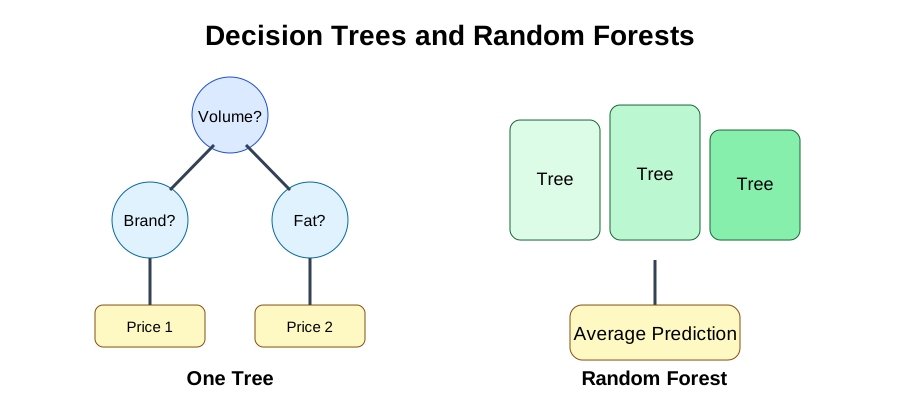
Minimal diagram
Volume > 1000 ml?

├── Yes
│   ├── Brand = Premium?
│   │   ├── Yes → Predicted Price = 2.50
│   │   └── No  → Predicted Price = 1.90
│
└── No
    ├── Fat = Full?
    │   ├── Yes → Predicted Price = 1.30
    │   └── No  → Predicted Price = 1.10
A tree learns a sequence of decisions rather than estimating a coefficient.
24.1 What is a Decision Tree?
A Decision Tree is a prediction model based on repeated splitting of the data. The algorithm searches for questions that best separate observations into groups with similar outcomes.
Examples of splitting questions include:
- Is volume greater than 1000 ml?
- Is the brand premium?
- Is the product fresh milk?
Each split creates more homogeneous groups. The final prediction is based on observations within each terminal group, called a leaf.
24.2 How a tree learns
For regression problems, the algorithm searches for splits that reduce prediction error. The tree repeatedly asks:
Which variable and cutoff value produce the largest improvement in prediction?
A split at 750 ml, for example, may separate low-price products from high-price products. The process continues until stopping criteria are reached.
Unlike regression, the model does not require linear relationships, log transformations, or manually specified interactions.
24.3 Advantages and limitations
Advantages
- Easy to visualize.
- Captures nonlinear relationships.
- Handles interactions automatically.
- Requires fewer statistical assumptions.
Limitations
- Sensitive to small changes in data.
- Large trees can overfit.
- Predictions may be unstable across samples.
Although trees are intuitive, a single tree can be fragile. This motivates Random Forests.
24.4 Overfitting in trees
A very large tree may fit the training data almost perfectly. This can be misleading. The tree may learn random noise rather than general patterns.
A model should capture reusable structure, not memorize individual observations.
24.5 Random Forests
A Random Forest builds many trees. Each tree uses a random sample of observations and a random subset of variables. The final prediction is the average prediction across all trees.
Tree 1 → 1.80 OMR
Tree 2 → 1.95 OMR
Tree 3 → 1.75 OMR
Tree 4 → 1.90 OMR

Final prediction = 1.85 OMR
Combining many trees reduces the influence of unusual observations and random noise.
24.6 Estimating a Decision Tree
Interpretation
The model learns a sequence of splitting rules from the training data. Predictions are generated using the final tree structure.
24.7 Estimating a Random Forest
from sklearn.ensemble import RandomForestRegressor

forest_model = RandomForestRegressor(
    n_estimators=200,
    random_state=4107
)

forest_model.fit(X_train, y_train)
forest_predictions = forest_model.predict(X_test)
Interpretation
The model combines information from many trees. This usually improves predictive accuracy and reduces overfitting.
24.8 Comparing models
from sklearn.metrics import mean_squared_error

tree_rmse = mean_squared_error(y_test, tree_predictions) ** 0.5
forest_rmse = mean_squared_error(y_test, forest_predictions) ** 0.5

print("Tree RMSE:", round(tree_rmse, 3))
print("Forest RMSE:", round(forest_rmse, 3))
Tree RMSE: 451.44
Forest RMSE: 412.601Example comparison:
| Model | RMSE |
|---|---|
| Linear Regression | 0.31 |
| Decision Tree | 0.28 |
| Random Forest | 0.21 |
Lower prediction error indicates stronger predictive performance. However, lower RMSE does not automatically imply better economic understanding.
24.9 Variable importance
Random Forests can estimate which predictors contribute most to prediction.
| Variable | Importance |
|---|---|
| Volume | 0.52 |
| Brand | 0.25 |
| Fat | 0.14 |
| Package | 0.09 |
Higher values indicate greater predictive contribution. They do not measure causality.
WarningCommon mistake
Do not treat Random Forest variable importance as evidence of causal effects. It identifies predictors that help forecast outcomes, not variables that necessarily cause outcomes.
Key takeaway
- Decision Trees create predictions using a sequence of rules.
- Trees naturally capture nonlinear relationships.
- Large trees may overfit the training data.
- Random Forests combine many trees to improve prediction accuracy.
- Variable importance measures predictive contribution, not causality.
Looking ahead
In the next chapter, we introduce XGBoost and compare its performance with regression, decision trees, and Random Forests.