WTO Chair Programme
The WTO Chairs Programme is a World Trade Organization capacity-building initiative that supports selected academic institutions in developing and least-developed countries through research, curriculum development, and outreach. This page explains the purpose and structure of the programme, its historical development, Sultan Qaboos University’s connection to the programme, and practical guidance for institutions preparing future applications. Interested academic teams are welcome to contact Prof. Osman Gulseven for discussion or collaboration.
This page presents academic, teaching, outreach, and policy-dialogue activities connected to the WTO Chair role at Sultan Qaboos University. It does not imply that Prof. Osman Gulseven formally speaks for the Government of Oman or for the WTO Secretariat.
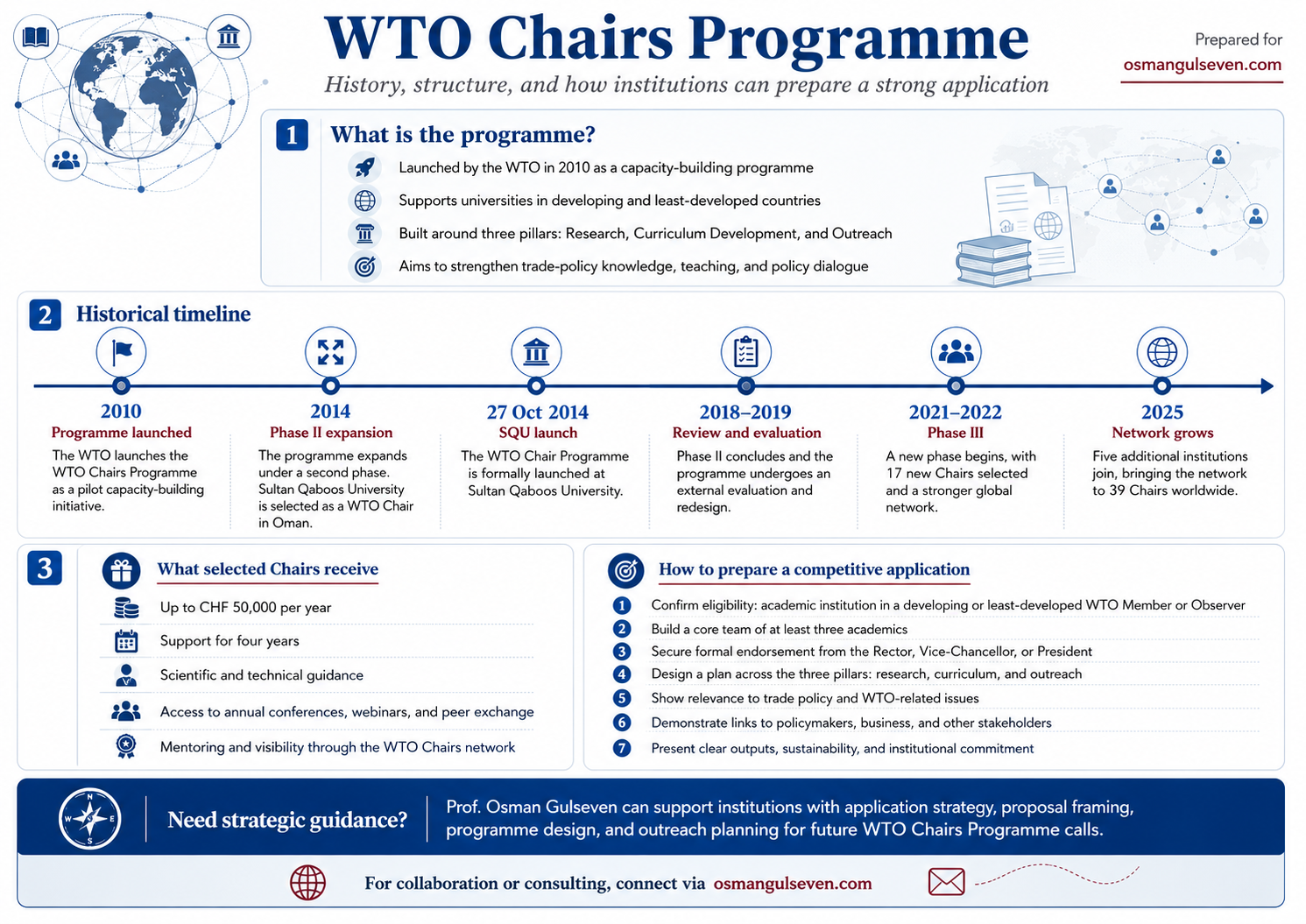
What is the WTO Chairs Programme?
The WTO Chairs Programme was launched by the World Trade Organization in 2010 as a capacity-building programme for academic institutions in developing and least-developed economies. It helps universities and research institutions strengthen trade-policy knowledge and support informed discussion of the multilateral trading system.
The programme works through three connected pillars: research, curriculum development, and outreach. These pillars are intended to improve trade-related academic output, teaching capacity, and communication with policymakers and other stakeholders.
For participating institutions, the programme creates a structured platform for academics, students, policymakers, business communities, and civil-society stakeholders to engage with WTO-related issues through evidence-based research, teaching, and public dialogue.
Historical background
The infographic above provides the main visual timeline. In brief:
- 2010: The WTO Chairs Programme was launched as a capacity-building initiative.
- 2014: The second phase expanded the network, and Sultan Qaboos University was selected as one of the additional WTO Chairs.
- 27 October 2014: The WTO Chairs Programme was formally launched at Sultan Qaboos University in Oman.
- 2018 to 2019: Phase II concluded, followed by external evaluation and redesign work.
- 2021 to 2022: Phase III was launched with 17 new Chairs and a renewed network approach.
- 2025: The network expanded further, reaching 39 Chairs worldwide.
Sultan Qaboos University and Oman
Sultan Qaboos University provides an academic platform for trade-policy teaching, applied research, and outreach in Oman and the GCC. The WTO Chair role at SQU connects WTO-related knowledge with Oman-relevant and regionally relevant themes, including food security, fisheries, regional integration, non-tariff measures, trade facilitation, sustainability, and applied policy analysis.
Prof. Osman Gulseven’s current WTO Chair work is presented here as an academic and capacity-building platform. It should not be read as official government representation or as a statement on behalf of the WTO Secretariat.
Core areas of work
Research and policy analysis
Applied research on trade policy, GCC integration, food security, fisheries, sustainability, and evidence-based policy dialogue.
Curriculum development
International trade teaching, WTO-related course content, simulation-based learning, TINA trade simulations, applied data work, and public teaching infrastructure such as the NREC4410 International Agricultural Trade coursebook.
Outreach and stakeholder engagement
Seminars, workshops, policy dialogue, student engagement, and communication with institutional partners where activities are verified.
Student training
Policy briefs, trade simulations, data visualization, applied econometrics projects, and practical trade-policy assignments.
International collaboration
Engagement with WTO Chairs, universities, ministries, and research partners through academic and policy-oriented activities.
Guidance for future WTO Chairs Programme applicants
Universities interested in future WTO Chairs Programme calls may benefit from early preparation. Strong applications usually need clear research, teaching, outreach, and institutional-capacity components that reinforce one another over a realistic implementation period. Any future application requirements must follow the official WTO Chairs Programme call documents.
Future applicants should prepare around these areas:
- Institutional fit: Explain why the university is well placed to host a WTO Chair, including faculty capacity, policy relevance, student reach, and regional trade-policy context.
- Research pillar: Define a focused research agenda linked to trade policy, WTO agreements, regional integration, food security, services, digital trade, sustainability, or development.
- Curriculum and training pillar: Show how WTO-related content will be embedded into courses, executive training, workshops, student projects, simulations, or policy labs.
- Outreach and policy dialogue: Identify realistic stakeholders, including ministries, chambers of commerce, customs agencies, private sector groups, researchers, and international organizations.
- Capacity building and sustainability: Explain how the programme will continue beyond the funding cycle through courses, research teams, data resources, teaching materials, and institutional partnerships.
- Evidence and impact narrative: Prepare evidence on student numbers, faculty expertise, existing trade-related work, stakeholder demand, and expected policy or educational outcomes.
Suggested preparation checklist
Guidance for future WTO Chairs Programme applications
This page describes academic experience and capacity-building interests connected to the WTO Chairs Programme. Interested academic teams are welcome to contact Prof. Osman Gulseven for discussion or collaboration on research agendas, curriculum planning, outreach design, and institutional-capacity narratives.
Prof. Osman Gulseven does not speak on behalf of the WTO or the Government of Oman. Application planning should be checked against the official WTO Chairs Programme call documents for the relevant year.
Working principles
- Keep claims tied to verified public sources.
- Separate academic analysis from official government positions.
- Add event details only when dates, partners, and public links are verified.
- Use public or teaching-approved datasets for released teaching materials.
- Treat public coursebooks, including NREC4410 International Agricultural Trade, as examples of teaching infrastructure rather than official policy statements.
- Describe collaborations cautiously unless public evidence supports the details.