TINA Trade Research Project
Using the Trade Intelligence & Negotiation Adviser in International Trade Classes
From tariff theory to negotiation analysis
This page explains how students can use the Trade Intelligence & Negotiation Adviser, or TINA, to conduct a structured international trade research project in an international trade class.
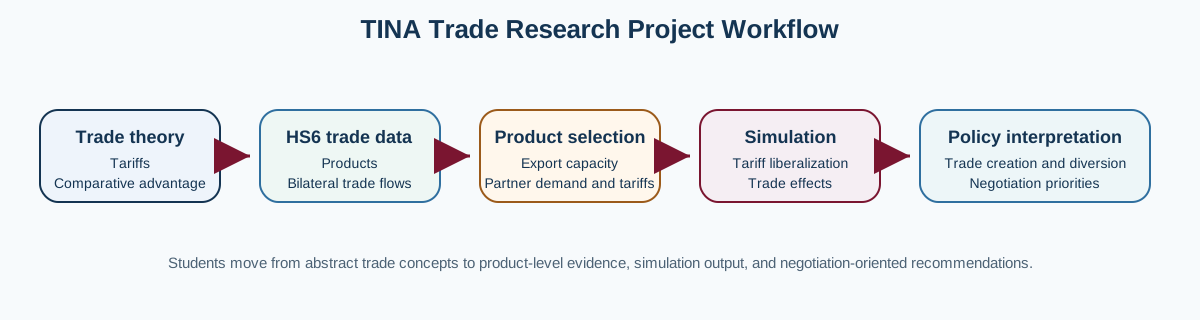
The workflow guides students from trade theory to HS6 product-level data, from tariff schedules to simulation results, and from numerical output to policy-oriented negotiation priorities. Related coursebook activities and policy-brief exercises are available through the NREC4410 International Agricultural Trade course website.
Course context: NREC4410 International Trade
Course website: NREC4410 International Agricultural Trade Institution: Sultan Qaboos University
Project format: Group research report and oral presentation
Main tool: TINA: Trade Intelligence & Negotiation Adviser
Project focus
Students act as trade policy analysts. They select a bilateral trade relationship, examine product-level trade patterns, identify offensive interests, simulate tariff liberalization, and communicate negotiation recommendations.
Key elements:
- HS6 product-level trade analysis
- bilateral trade baseline
- offensive product selection
- tariff liberalization simulation
- trade creation and trade diversion interpretation
- policy-oriented negotiation priorities
Why TINA belongs in an international trade class
International trade courses often introduce tariffs, comparative advantage, trade creation, and trade diversion through models and diagrams. TINA helps students connect those concepts to actual trade policy work.
The purpose is not simply to teach students how to click through a platform. The purpose is to help them ask better policy questions:
- Which products matter in a bilateral trade relationship?
- Where does the home country have plausible export capacity?
- Which tariff barriers are relevant for negotiation?
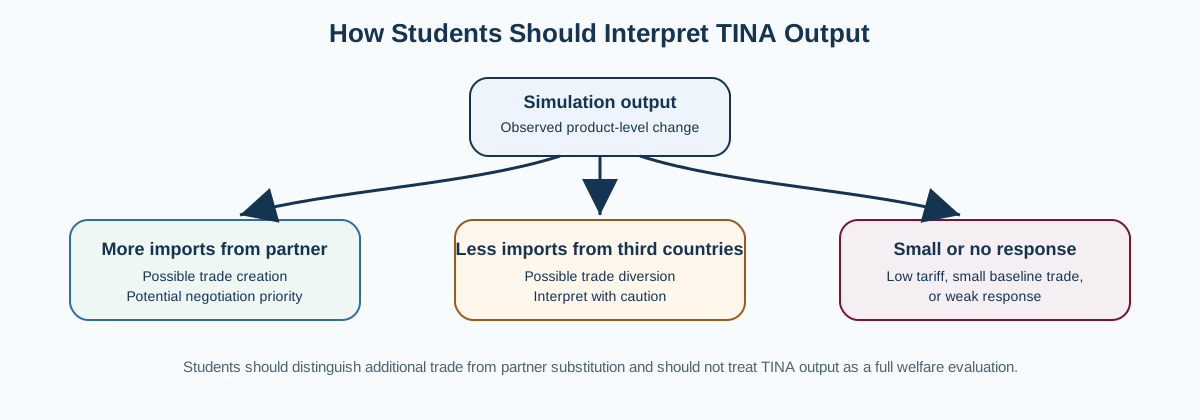
- How should simulated trade creation and trade diversion be interpreted?
- Which products deserve priority in a trade negotiation?
Teaching position: TINA is used here as an applied learning environment. It supports trade policy reasoning, but its simulation results should be interpreted cautiously. The exercise is a teaching framework, not a claim of causal learning gains.
What students learn
Theory to data
Students connect comparative advantage, tariffs, market access, and product concentration to observable HS6-level trade indicators.
Data to simulation
Students examine how tariff changes, baseline trade values, tariff exposure, and elasticity assumptions affect simulated trade outcomes.
Simulation to policy
Students translate trade creation, trade diversion, and tariff exposure into negotiation priorities and policy recommendations.
Project workflow
The assignment can be organized as a five-stage trade research project.
1. Build the bilateral trade baseline
Students select two countries and describe the structure of trade between them. They identify leading export and import products, product concentration, and asymmetries between the partners.
Suggested output: baseline trade table, top HS6 products, and short interpretation of trade structure.
2. Identify offensive products
Students construct a negotiation list using evidence of export capacity, partner demand, current tariffs, and revealed comparative advantage. The goal is to avoid mechanical product selection and require economic justification.
Suggested output: offensive product list with selection criteria.
3. Simulate tariff liberalization
Students use TINA to simulate tariff reduction or elimination for selected products. They must remember that the relevant tariff is the importing country’s tariff, not the exporting country’s tariff.
Suggested output: simulation table showing baseline trade, tariff, change in trade value, trade creation, and trade diversion where available.
4. Interpret trade creation and trade diversion
Students explain whether the simulated change reflects additional imports from the partner, reallocation away from third-country suppliers, or both. They also discuss the role of elasticities and baseline trade values.
Suggested output: interpretation paragraph for each priority product group.
5. Prepare negotiation-oriented recommendations
Students convert the simulation results into a concise policy message. They rank priority products, explain the economic logic, and state the limitations of the analysis.
Suggested output: final report, presentation slides, and reproducibility appendix.
Recommended project timeline
| Stage | Timing | Main activity | Expected student output |
|---|---|---|---|
| Introduction | Week 1 | Introduce TINA and explain the assignment | Initial understanding of project requirements |
| Country selection | Week 2 | Select a bilateral trade pair | Confirmed country pair and group members |
| Baseline analysis | Weeks 3 to 4 | Examine trade flows and product concentration | Baseline tables and graphs |
| Product selection | Weeks 5 to 6 | Build offensive product list | Draft negotiation list |
| Tariff simulation | Weeks 7 to 8 | Simulate tariff liberalization | Simulation output tables |
| Interpretation | Weeks 9 to 10 | Link results to trade theory | Draft report and presentation outline |
| Communication | Final week | Present findings and submit report | Final report and oral presentation |
Student deliverables
Students submit two main outputs.
Written trade policy report
The report should include the bilateral trade baseline, product selection logic, simulation outputs, interpretation, policy recommendations, and reproducibility notes.
Oral presentation
The presentation should communicate the main findings clearly, using tables, figures, and short policy-oriented conclusions.
Suggested report structure
- Introduction and country-pair justification
- Bilateral trade baseline
- Product selection method
- Tariff simulation scenario
- Simulation results
- Trade creation and trade diversion interpretation
- Negotiation priorities
- Limitations
- Reproducibility appendix
Suggested assessment rubric
| Criterion | Weight | Evidence in student work |
|---|---|---|
| Correct use and documentation of TINA | 20% | Screenshots, exported tables, simulation settings, source notes |
| Baseline trade analysis | 15% | Accurate description of export and import structure at HS6 level |
| Product selection logic | 15% | Justified offensive list based on export capacity, partner demand, tariffs, and comparative advantage |
| Simulation interpretation | 20% | Correct explanation of trade creation, trade diversion, tariffs, and elasticities |
| Policy recommendations | 15% | Coherent negotiation priorities linked to simulation results |
| Presentation and communication | 10% | Clear visuals, concise explanation, and effective response to questions |
| Reproducibility appendix | 5% | Simulation date, data year, tariff scenario, elasticity settings, exported output |
Example teaching case: Oman and India
The Oman and India trade relationship can be used as an applied classroom example because it allows students to examine asymmetry in bilateral trade structure.
Students may compare:
- Oman’s potential export interests in the Indian market
- India’s potential export interests in the Omani market
- differences in product concentration
- tariff exposure by product
- simulated changes in trade values
- trade creation and trade diversion effects
- negotiation priorities for each side
The case should be presented as a teaching application, not as a full welfare evaluation of a trade agreement.
Important cautions for students
TINA simulations are useful for applied interpretation, but they are not complete welfare estimates.
Students should explicitly state that the results may depend on:
- baseline trade year
- tariff data year
- tariff reduction scenario
- product selection filters
- elasticity assumptions
- missing trade or tariff data
- treatment of third-country suppliers
- partial equilibrium assumptions
Core limitation: TINA focuses on product-level partial equilibrium effects. It does not capture economy-wide feedback, factor reallocation, fiscal effects, exchange-rate adjustment, or long-run productivity effects.
Reproducibility checklist
| Item | What to document |
|---|---|
| Simulation date | Date on which the TINA simulation was run |
| Baseline trade year | Import data year selected in TINA |
| Tariff year | Tariff data year or latest available tariff data used by TINA |
| Tariff scenario | Full elimination, partial reduction, or staged liberalization |
| Product filters | Export capacity, partner demand, tariff presence, RCA, or other filters |
| Elasticity settings | Default or user-selected elasticity assumptions |
| Units | US dollars, millions, percentages, or other units |
| Missing data | Products excluded due to missing trade, tariff, or elasticity data |
| Exported output | CSV files, screenshots, or appendix tables |
Instructor use
This page can support several teaching formats:
- undergraduate international trade project
- WTO and trade policy simulation workshop
- applied trade policy lab
- active learning module for economics students
- short professional training exercise on tariff negotiation analysis
Citation note
This teaching page is based on Dr. Osman Gulseven’s classroom framework for integrating the Trade Intelligence & Negotiation Adviser into undergraduate international trade teaching at Sultan Qaboos University.